Fofonoff flow
19 May 2023 by MiniUFO
[TOC]
1. Introduction
Early models of wind-driven oceanic circulation have been developed from linearized equations, with forcing and dissipation. The neglect of nonlinear advection terms in these equations has greatly simplied the mathmatical manipulations. These models represent that the ocean circulation asymptotes to a steady state when forcing and disspation are approximately cancelled.
Alternatively, in a seminal paper, Fofonoff (1954) retained the nonlinear terms but neglected the forcing and dissipation. With an initial input of energy, the flow will also asymptote (approaching) to a steady state, in which the potential vorticity (PV) contour \(q\) coinside with those of streamfunction \(\psi\), forming a functional \(\psi(q)\). This indicates the advection of PV is exactly zero, hence a steady state of the circulation.
2. Theory
2.1 Fofonoff’s derivation
Fofonoff (1954) started from the 2D non-divergent barotropic model. This is the simplest 2D nonlinear model:
Following Fofonoff (1954), one remove the tendency terms to obtain the steady state equation in vector form from Eqs. (1-2):
Here \(\mathbf{\hat u}=(-v, u)\) is the 90° anti-clockwise rotation of \(\mathbf u\). This is equivalent to:
Introducing streamfunction \(\psi\) and Bernouli function \(Q\), Eq. (5) is:
implying \(Q=Q(\psi)\) and \(\zeta_a=-dQ/d\psi\).
2.2 A simpler derivation
A more elegant way to derive the balance relation starts from the barotrpic vorticity equation, which is equivalent to equations (1-3):
where \(J(A,B)=\partial_x A\partial_y B-\partial_y A\partial_x B\) is the Jacobian operator. Assuming steady state immediately gives \(J\left(\psi, \zeta_a\right)=0\). This implies a functional relation between the streamfunction and absolute vorticity as \(\psi = \psi(\zeta_a)\), so that:
where \(\hat\nabla=(-\partial_y, \partial_x)\). The last equality holds because the curl of a scalar is perpendicular to its divergence.
2.3 Stead-state flow
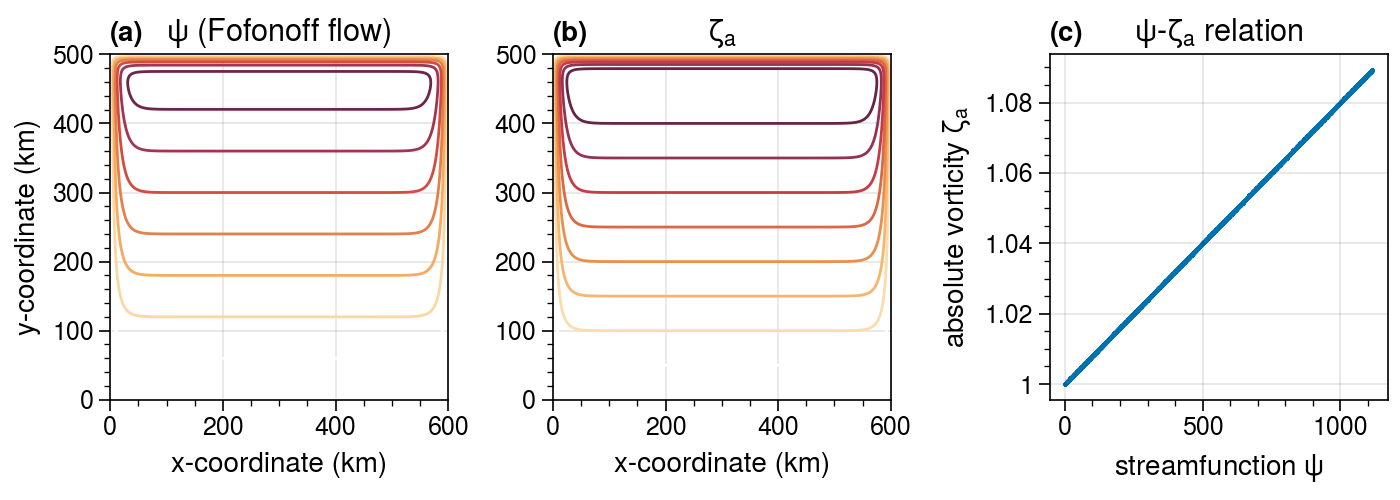
The above derivations show that, if a flow satisfies the steady state, the absolute vorticity should be a constant along a streamline. Fofonoff (1954) used a simple linear relation between streamfunction and absolute vorticity as \(\zeta_a = c_0\psi+c_1\), which yield a 2D elliptic equation as:
It is important to note that:
if \(c_0>0\), Eq. (9) is a screened Poisson equation, which can be easily solved using
xinvert;if \(c_0<0\), Eq. (9) is a inhomogeneous Helmholtz equation, which is NOT readily solvable using iterative method;
3. Examples
Here we will demonstrate how to use xinvert python package to invert Eq. (14), and nonlinear loops for inverting Eq. (8). First we define a rectangular domain and its coordinates.
3.1 Classical Fofonoff flow
[1]:
# construct domain, coordinates, and forcing
import xarray as xr
import numpy as np

xc = np.linspace(0, 600000, 301)
yc = np.linspace(0, 500000, 251)

xdef = xr.DataArray(xc, dims='x', coords={'x':xc})
ydef = xr.DataArray(yc, dims='y', coords={'y':yc})

F = ydef - xdef # broadcast to 2D forcing
[2]:
# invert for streamfunction
import sys
sys.path.append('../../../')
from xinvert import invert_Fofonoff

iParams = {
    'BCs'      : ['fixed', 'fixed'],
    'mxLoop'   : 4000,
    'tolerance': 1e-14,
    'optArg'   : 1.2}

mParams = {
    'f0'  : 1e-4,
    'beta': 2e-11,
    'c0'  : 8e-9,
    'c1'  : 1e-4}

sf = invert_Fofonoff(F, dims=['y', 'x'], coords='cartesian', iParams=iParams, mParams=mParams)
{} loops 1174 and tolerance is 9.362824e-15
[6]:
# plot the flow pattern
import ultraplot as uplt

fig, axes = uplt.subplots(ncols=3, figsize=(7,2.5), sharex=0, sharey=0)
fig.set_facecolor('w')
fontsize = 11

ygrid, xgrid = xr.broadcast(ydef, xdef)

ax = axes[0]
ax.contour(sf, levels=11, lw=1)
ax.set_ylabel('y-coordinate (km)', fontsize=fontsize-1)
ax.set_xlabel('x-coordinate (km)', fontsize=fontsize-1)
ax.set_yticks([0, 100000, 200000, 300000, 400000, 500000])
ax.set_xticks([0, 200000,400000, 600000])
ax.set_yticklabels(['0', '100', '200', '300', '400', '500'])
ax.set_xticklabels(['0', '200','400', '600'])
ax.set_title('$\\psi$ (Fofonoff flow)', fontsize=fontsize)

zeta = mParams['c0'] * sf + mParams['c1']

ax = axes[1]
ax.contour(zeta, levels=11, lw=1)
ax.set_ylabel('', fontsize=fontsize-1)
ax.set_xlabel('x-coordinate (km)', fontsize=fontsize-1)
ax.set_yticks([0, 100000, 200000, 300000, 400000, 500000])
ax.set_xticks([0, 200000,400000, 600000])
ax.set_yticklabels(['0', '100', '200', '300', '400', '500'])
ax.set_xticklabels(['0', '200','400', '600'])
ax.set_title('$\\zeta_a$', fontsize=fontsize)

ax = axes[2]
ax.scatter(sf.values.ravel(), zeta.values.ravel()*1e4, s=0.4)
ax.set_ylabel('absolute vorticity $\\zeta_a$', fontsize=fontsize-1)
ax.set_xlabel('streamfunction $\\psi$', fontsize=fontsize-1)
ax.set_title('$\\psi$-$\\zeta_a$ relation', fontsize=fontsize)

axes.format(abc='(a)')
3.2 global Fofonoff flow
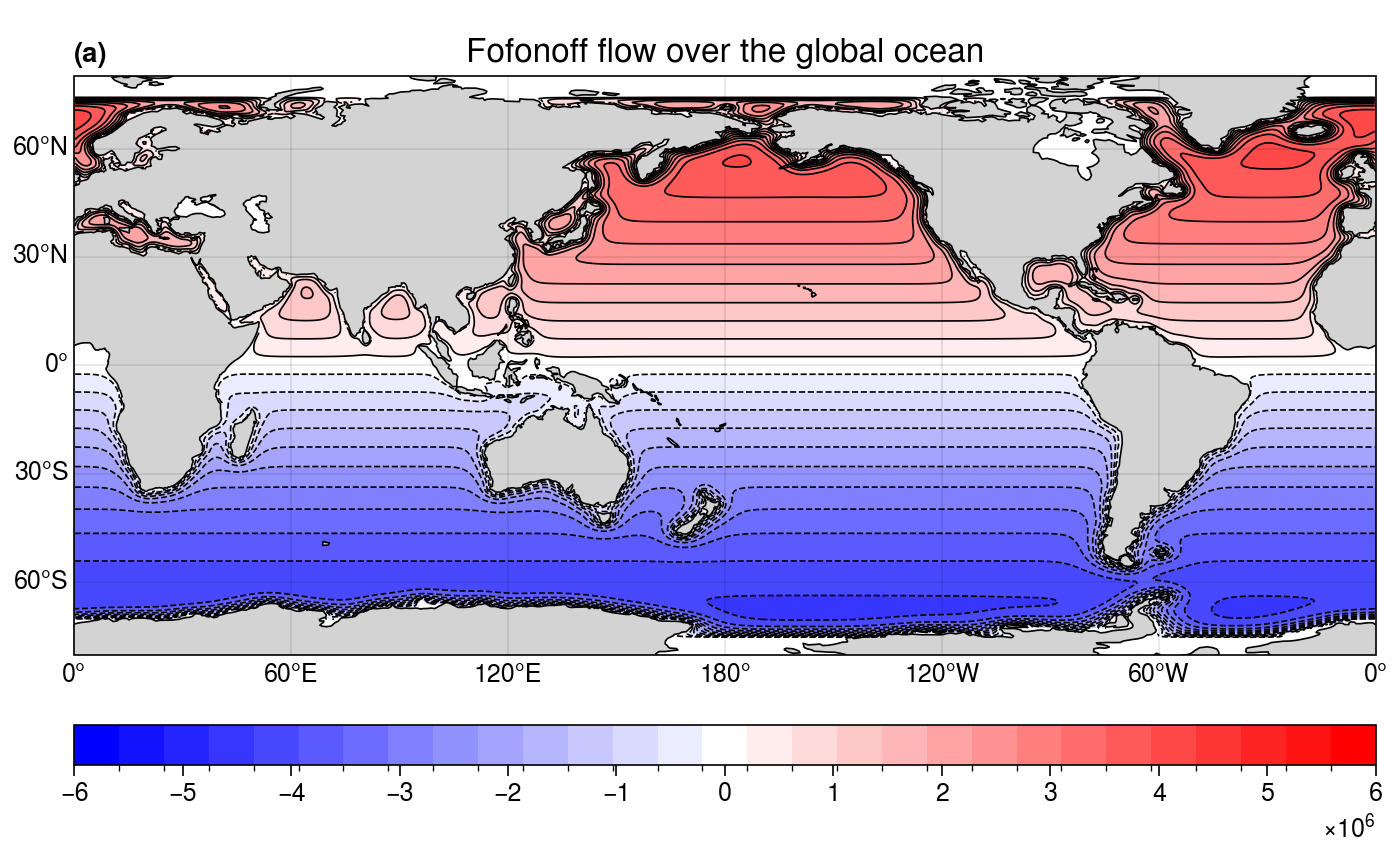
[7]:
# load in wind stress from SODA product
ds = xr.open_dataset('../../../Data/SODA_curl.nc')
curl = ds.curl

iParams = {
    'BCs'      : ['fixed', 'periodic'],
    'mxLoop'   : 5000,
    'tolerance': 1e-18,
    'optArg'   : 0.3}

mParams = {
    'c0': 3e-11,
    'c1': 0}

sf = invert_Fofonoff(curl[0], dims=['lat', 'lon'], coords='lat-lon', iParams=iParams, mParams=mParams)
{} loops 5000 and tolerance is 3.336618e-09
[9]:
# plot the flow pattern
import ultraplot as uplt

fontsize = 12

fig, axes = uplt.subplots(figsize=(7, 4.3), sharex=3, sharey=3, proj='cyl', proj_kw={'central_longitude':180})
fig.set_facecolor('w')
ax = axes[0]
m = ax.contourf(sf, levels=np.linspace(-6e6, 6e6, 30), cmap='bwr')
ax.contour(sf, levels=np.linspace(-6e6, 6e6, 30), lw=0.6, color='k')
ax.colorbar(m, loc='b', ticks=1e6, label='', length=1)
ax.set_title('Fofonoff flow over the global ocean', fontsize=fontsize)
ax.set_ylim([-80, 80])

axes.format(abc='(a)', land=True, coast=True, lonlabels='b', latlabels='l', lonlines=60, latlines=30, landcolor='lightgray')
References
Fofonoff, N. P., 1954: Steady flow in a frictionless homogeneous ocean. J. Marine Res., 14, 254-262.